
Could The CPI Deceleration Give The Fed Room To Cut? Watch The 2 YR Yield.

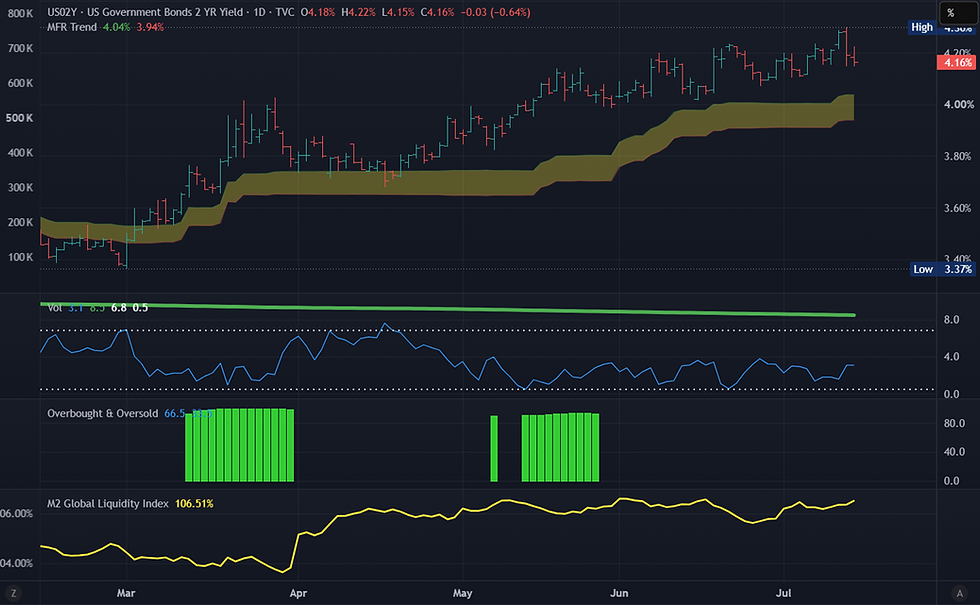
1.) CPI – Fed Chair Waller put a lot of emphasis on inflation breadth during his recent Congressional testimony. June CPI was undoubtedly soft from a breadth perspective. Only 43% of the basket is running above 2.5% annualized inflation, which is the lowest since Feb '25. Will this give room for the Fed to – at the very least – NOT raise rates? Could it be enough for them to actually cut yet this year? Hard to say, but the 2 YR Treasury responded in a way that would suggest either is possible. The 2 YR Treasury Yield is the “Fed proxy,” and it was down 9 basis points on the day and another 4 basis points this morning. That’s a fair amount. This yield needs to break 3.94% before it flips to a bearish (downward) trend. If that were to happen, it would be the market telling the Fed – NO rate hikes…CUT! We’ll let the signal tell us what’s next.
2.) HORMUZ – “Zero Hormuz Dependency.” That was buried in the headlines late Monday. It sounds like something only a government bureaucrat could get excited about. But it could become one of the biggest investing stories of the next decade. Imagine you’re driving from Pennsylvania to Florida for a winter vacation. Halfway through the trip, someone tells you the only road south goes through Texas first. You’d think they were nuts. I mean, why would anyone build a road like that?! That’s basically how the global energy market works today. A huge amount of the world’s oil has to squeeze through one tiny stretch of water called the Strait of Hormuz before it can reach the rest of the world. The United Arab Emirates thinks that’s nuts and has been working on building pipelines, ports, storage tanks, and export terminals that let ships load on the other side and head straight into the open ocean. That’s all “Zero Hormuz Dependency” means. It’s not about digging another canal. It’s about building another route. That got me thinking about the Suez Canal. Bear with me here. The Suez Canal cut thousands of miles off the journey between Europe and Asia. Here’s the point. The biggest winners weren’t the people collecting tolls. The biggest winners were the businesses that suddenly had a better road. Shipping companies could make more voyages every year. Shipbuilders received more orders, and ports became booming cities. Banks financed more deals, and factories could suddenly sell their products to places that had been too expensive to reach. The canal didn’t create commerce. It made commerce easier. “Zero Hormuz Dependency” isn't really an oil story, but another infrastructure story. This seems to confirm that the world is building again. Artificial intelligence needs enormous amounts of electricity. Electricity needs natural gas, nuclear power, and transmission lines. Natural gas needs pipelines. Pipelines feed export terminals. Export terminals need ports. Every one of those projects needs steel, copper, valves, pumps, electrical equipment, engineering firms, and construction crews. One project creates work for another, and then another after that. That’s growth! The Suez Canal changed the world 150 years ago by making trade easier. If the world really starts building ways to reduce its dependence on the Strait of Hormuz, history suggests we shouldn’t just watch the headlines, but look for the companies building the pipelines, ports, and export terminals that make the new route possible.

3.) YIELD CURVE – The yield curve, typically expressed as the US 10YR yield minus the 2YR yield, tends to get people all worked up if it inverts. Many get worked up if it is just declining or tightening! The curve has had a sharp move higher recently from 0.25% to 0.41%; that’s a decent move. The curve is still in a downward bias, but a break and hold above 0.43% would suggest growth is returning. So far, so good.


