
MAG7 Losing the Lead as Market Breadth Expands
- Chris Kline

- Jan 20
- 3 min read
Updated: Feb 12
1) INFLATION – Yes, inflation is decelerating. But the bond market is likely telling the Fed that inflation isn’t “over” yet either. Remember, 10, 20, and 30-year yields never broke TREND (that is the Rate of Change of Price, Volume, and Volatility over a period of greater than 3 months). They tested TRENDs last week and are now flying higher with yields up anywhere from 6 to 9 basis points…which is a fair amount in a day for longer-dated yields. But those pale in comparison to what Japan is getting this AM with their 30-year yield up a whopping 31 basis points. Last week we reduced our bond exposure as our algorithms were likely “seeing” Bond Volatility (MOVE Index) at an intermediate-term low for the cycle and those longer-dated yields not able to break down. We’ll see, but much of this is happening on the back of the new “tariff news.” I think it’s instructive to remember how the “tariff news” cycle tends to go: (1) Tariff announcements are usually dropped late Friday or over the weekend while US markets are closed; (2) then initial tariffs are announced with an escalation window, creating shock plus a negotiation deadline; (3) then the first market move is mechanical, driven by risk rules, margin changes, volatility models, and forced deleveraging; (4) then liquidity disappears quickly, causing sharp and fast price moves; (5) then after the selloff, officials shift the tone to negotiations and constructive talks; (6) then a delay, reduction, or partial deal follows and markets recover as uncertainty fades. We’ll see if this time is the same. History suggests it probably is.
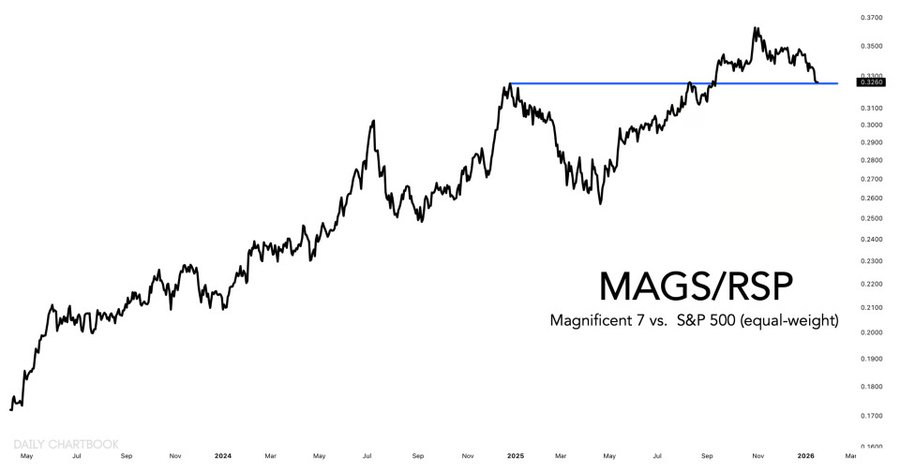
2) MAG7 – The parts of the market that are struggling are the very same names that used to "carry all the weight." That shift matters. As you can see in the picture below, the “Magnificent 7” stocks have been lagging a broadening degree of overall market participation as the S&P 500 Equal Weight (RSP) has been leading the MAG7 names. Again, most stocks today are going up as market participation has broadened. That is overall bullish in nature. We just have to be mindful that rotation like this can be a sign of a healthy bull market broadening out, but it can also be the early stages of something far more disruptive. Mega-cap growth is underperforming small caps as the Nasdaq 100 has been lagging those small names for several months now. But that is just rotation. Indexes with a lot more industrials, financials, and natural resources are outperforming the indexes loaded with mega-cap US growth – like the Nasdaq 100.
3) VIX – Being patient with “newsy” events like today matters – super-short-term clusters of volatility are NOT TRENDING volatility. Implied Volatility (IVOL) is also still very high with the SPY (S&P 500 proxy) implied volatility PREMIUM at 109%. Those levels of hedging tend to keep markets from all-out crashing. Can they have corrections with IVOLs that high? Sure. FEB 27, 2025, the S&P 500 dropped -1.59%. At that time, SPY Implied Volatility was just at a 48% PREMIUM. The VIX Futures curve was also “backward” in that the VIX spot level was between 18-19 while front month futures (months 1 and 2) were below that spot figure. That “backwardation” as it’s called, oftentimes signals risk much higher in the immediate term versus a couple of months out, suggesting volatility could pick up. Right now, we’re getting our first day of “backwardation” in the futures curve simply suggesting markets are pricing volatility much higher in the short term versus the next couple of months. That’s indicative of the Tariff “news” history cycle. Implied Volatility PREMIUMS are significantly higher now than back in FEB 2025 too…so the market is more well-hedged today versus then. Again, these are market structure elements that tend to keep markets from an outright crash, but can certainly blow off some steam with a minor correction. Our algorithms reduced equity exposure last week.


