top of page

For informational and educational purposes only - not personalized investment advice. Nothing here should be relied upon to make investment decisions. All investments involve risk, including possible loss of principal, and past performance does not guarantee future results. References to specific securities or market indicators are illustrative only and not a recommendation. Opinions are as of publication date and subject to change.

Shorts Tell Us The Market Is Well Hedged

  • Writer: Chris Kline
    Chris Kline
  • 6 hours ago
  • 2 min read

1.) RATES – There are more and more people becoming “concerned” with the bond market and rising rates. But let’s look at some facts. First, volatility is still under control as the MOVE Index put in a lower high on May 18 and is below trend again. Second, if you look at rates and earnings over a long history, you can see in the chart below that whenever earnings have risen like this, they have always brought interest rates up with them. The rate of change of revenues and earnings is where to see the truth. Q1 earnings data shows so far that 472 of S&P 500 companies have a YoY (year over year) growth acceleration of +27.5%, and of the NASDAQ 100, 90 companies have reported +46% YoY growth. So, maybe we shouldn’t be too worried about rates given the acceleration in earnings.
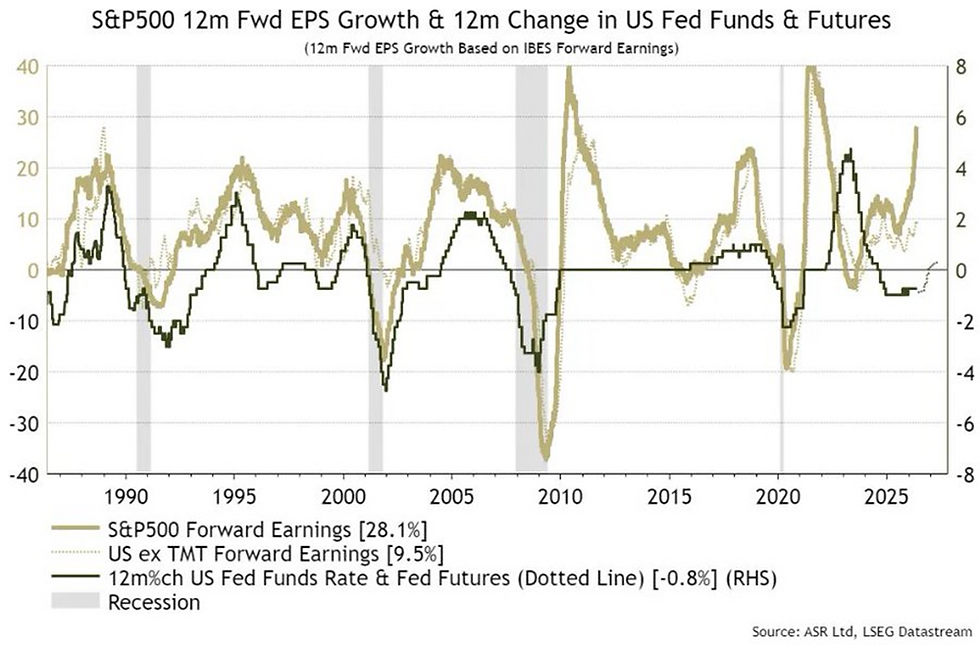

Line chart of S&P 500 forward EPS growth and Fed funds changes from 1990s–2025, with recession bands and legend text.

2.) SHORTS – I’ve discussed in the past how a healthy (large) short position in markets is good for the bulls. It places a hedge underneath the market. If that’s the case, then it seems markets are well hedged. According to Goldman’s Prime Book, hedge funds have increased their short exposure to the highest level in at least the last decade. Remember, buyers don’t have to sell, but shorts have to eventually buy. That is an important distinction when short positions rise like this. It can also lead to a violent upside rally if those funds have to cover those shorts quickly.


Black line chart titled Prime Book: US Equity Macro Products, showing short exposure rising from 5% to near 13% by 2026, with red 13% level line

3.) P/E’s – More ink continues to be spilled about “high Price to Earnings ratios.” Sure, P/E’s are historically high, but we need to view them in context. What’s that context? What I pointed to in today’s first point…earnings growth. This year, valuations have actually compressed due to incredibly strong earnings growth. Don’t get hung up on the number; look at the rate of change of things. Since just the beginning of the year, the forward P/E (red line) for the S&P 500 is actually down about 5%. But forward earnings per share (teal line) are up.


Line chart titled Decomposition of the S&P 500's Year-to-Date Price Return, with S&P 500, Forward EPS, and Forward P/E lines from Jan to May 26.


References to model portfolios reflect proprietary model activity and do not represent any individual client account. Client portfolios may differ based on objectives, risk tolerance, tax considerations, and other factors. Model results do not guarantee individual performance. Capstone Wealth Management Corp. is an SEC-registered investment adviser; registration does not imply a certain level of skill or training. Fees, services, and additional information are available in our Form ADV.

Capstone Wealth Management Logo

© 2026 Capstone Wealth Management Corp. · SEC-Registered Investment Adviser

Capstone Wealth Management Corp. is an SEC-registered investment adviser. Registration does not imply a particular level of skill or training. This site is informational only and is not personalized investment, tax, or legal advice. Investing involves risk, including possible loss of principal. Past performance does not guarantee future results. See our Form ADV for full details on services, fees, and conflicts of interest.

bottom of page