Healthy Banks, Healthy Markets.

1.) BANKS – Over the past month, I’ve written about the strength in bank stocks. When it comes to markets, a mantra that is worth remembering is: the bigger the collapse, the longer the time needed for repair. That statement is reportedly attributed to technical analyst Louise Yamada. It makes sense. The bigger the damage in a market, sector, or stock, the longer it takes before confidence returns. I think that explains a lot of what we’re seeing today. The dot-com bubble peaked in 2000, and what followed was one of the biggest collapses any major sector has ever experienced. Things don’t heal overnight from something like that. It took almost 20 years before the Technology Sector (XLK) finally climbed back above its dot-com bubble highs. The repair had finally been completed. Nearly 20 years of investors who wanted to “just get their money back” had finally sold. The supply was gone, and there was room for a brand-new uptrend. I’m not saying it went up just because it spent 20 years repairing itself. But I also don’t think it’s a coincidence. This is why financials and banks are on my mind. The banking sector peaked before the Great Financial Crisis in 2007. It then spent nearly two decades working through one of the worst collapses in modern market history. Now, almost 19 years later, the repair appears to be complete. Maybe the most interesting part of this is how little attention this breakout in banks is getting! I like that. Healthy banks have historically been a good sign that healthy markets and healthy economies can continue.

2.) US DOLLAR – The Dollar Index (DXY) fell hard yesterday, dropping below a key level of $100.50. That is significant if it can hold and would suggest that the market could be moving back toward a “risk on” attitude. This would coincide with what I wrote about breadth yesterday getting stronger as the market pulled back/moved sideways. Does that mean the “correction” in stocks is over? Not necessarily. The market still has to contend with a bond market that doesn’t believe the Fed and keeps driving rates higher. But, we also have some very good earnings data for some of the biggest hyperscaler names in the market, suggesting that the AI spending is starting to pay off with all three seeing revenue accelerations vs. last quarter.
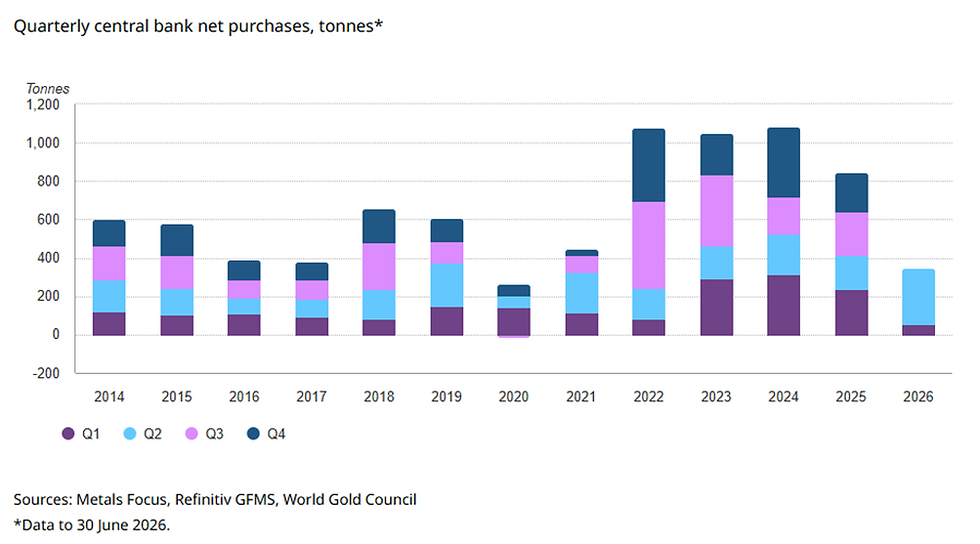
3.) GOLD – Gold currently has a fairly large inverse correlation to the US Dollar. Why does that matter? If the Dollar Index (DXY) changes its directional trend regime from upward (bullish) to downward (bearish), gold could benefit nicely. The Dollar Index needs to break below $99.40 and hold for that to change to a bearish trend. While this is happening, central bank net gold demand picked up significantly in Q2, reaching 289 tonnes. That’s a fivefold increase on Q1's revised estimate of 57 tonnes and a record high for a second quarter. All this is happening while gold has basically gone sideways since the beginning of June. That could be repair building under the surface. $3955 is an important level for gold to keep up the repair job.