How Much Liquidity Will SpaceX Pull From Everywhere Else?

1.) SPACEX – Well, I guess we have to discuss SpaceX to some extent. I don’t like talking about individual names, but I mean, after all, it is THE largest IPO (initial public offering) ever! Depending on where it ultimately opens, we’re talking about a company worth somewhere between $2 trillion and $3 trillion on the very first day of trading. At the upper end of that range, we’re approaching 10% of annual U.S. GDP. That’s almost surreal. Regardless of what anyone thinks about SpaceX, this is a market structure event as much as it is a company event. What really jumps out about this? The calendar. I know that sounds weird, but the largest IPO in history is scheduled to begin trading on a Friday, in the middle of summer?! That’s an extraordinary amount of capital trying to find a home in what is traditionally a relatively quiet market environment. But history tells us that enormous IPOs don’t always cooperate. The Facebook launch in 2012 was a complete disaster. Technical issues delayed executions and created confusion throughout the market. Investors were furious. Brokers were scrambling. Everyone was frustrated, and the Facebook IPO was tiny compared to this. History is also littered with massive IPOs (for that time) that saw a huge ramp up on IPO day, only to get clobbered over the next several months. Oftentimes, in the past, big IPOs pop and crash – US Steel in 1901, RCA in 1919, Ford in 1956, Blackstone in 2007, Facebook in 2012, Uber in 2019, Coinbase and Rivian in 2021… all had the same characteristics. They also took markets with them when they “corrected.” SpaceX doesn’t have to follow this pattern. I mean, history doesn’t repeat perfectly. But it rhymes often enough that I think it’s worth paying attention. As you know, I like magazine covers for a contrarian perspective. What’s interesting this time is that we’re already seeing the opposite side of the argument. Barron’s is questioning the valuation. As students of sentiment, we have to acknowledge that. Universal optimism is dangerous, but universal skepticism can be useful. Interestingly, SpaceX has both! There are a couple of things I don’t like about market structure going into this IPO. IPO access was lowered from $500,000 to $2,000 (-99.6% cut). That means millions of unsophisticated investors can suddenly enter a deal and buy these shares. SpaceX also reserved up to 30% of the deal for regular, retail investors. That’s about three times the normal share. So the big question for me is how much liquidity this IPO pulls from everywhere else, and is the retail army of investors getting set up as exit liquidity. Short term… probably. Long term, SpaceX is likely to be a transformative company worth double-digit trillions. Unless you received a pre-IPO allocation of shares, I’d stand back and watch the launch.

2.) GOLD – The yellow metal continues to unravel. I asked the question a few days ago if it just lost its footing as it broke the 200-day moving average. Typically, if an asset is going to get some buying support, it happens pretty quickly after a tap or slight break of that level. So far, that is not happening, and with each passing day, its weakness gets a little more pronounced. Also not helping is the fact that GLD, the largest spot gold Exchange Traded Fund, has seen steady outflows since the war began on Feb 27. While CPI sparked a brief bounce, momentum remains extremely weak, and the metal is now breaking below the key trend line… it’s getting close to a “do or die” area.
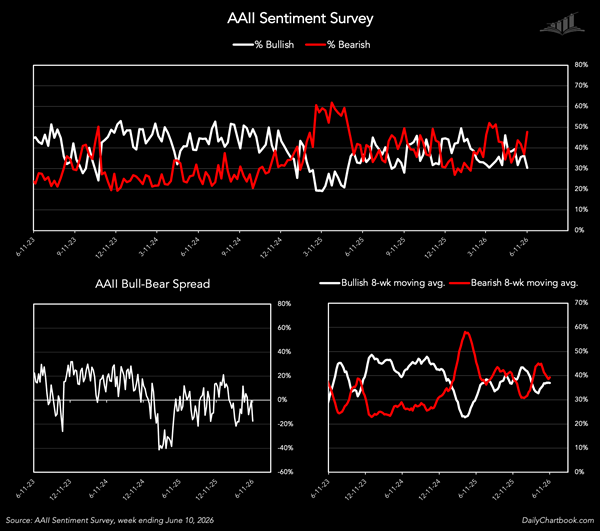
3.) SENTIMENT – More bears than bulls is usually good for a healthy, sustainable bull market. The American Association of Individual Investors Sentiment Survey came out, and bearish sentiment rose over the past week while bullish responses dropped to the lowest since Sep 25. That pushes the bull-bear spread down to a 10-week low. This is healthy.