Rates, Rates, Rates...And More Rates.

1.) RATES – Everyone is obsessed with interest rates. The Federal Reserve raised rates. Treasury yields jumped. Borrowing became more expensive, and so the assumption was pretty simple: Higher interest rates = bad for companies.
That’s a reasonable expectation since if it costs companies more money to borrow, they have less money left over for everything else. Except that’s NOT what happened.
The chart below is from the Financial Times and it shows net interest payments for U.S. non-financial companies as a percentage of the value they produce. Despite the biggest increase in interest rates in decades, the interest burden on corporate America has collapsed to around the lowest level in the history of the data.
How??!!
Companies borrowed enormous amounts of money when interest rates were near zero. The Fed has estimated that roughly 80% of the outstanding debt of publicly traded U.S. non-financial companies is at a fixed-rate.
But that’s not all.
While companies were still paying yesterday’s low interest rates, they suddenly started earning today’s high interest rates. Imagine a company borrowed (floated debt, etc.) $10 billion at 3%. That’s $300 million a year in interest expense. But suppose the company also has $5 billion sitting in cash and short-term investments. Now, imagine it’s earning 5%. That’s $250 million a year coming back the other way, making the net interest expense is only $50 million.
Higher rates actually helped!
That’s what’s important in this chart…NET interest payments.
Now, of course, that doesn’t mean higher rates are good for every company…they’re not. A company with tons of cash and old fixed-rate debt is in a different position from a company that constantly needs to borrow money.
Eventually, some of that cheap debt Corporate America borrowed years ago will mature. But that’s also why higher rates can take years to work their way through the economy.
Moreover, Corporate America has continued to grow.
So the chart below is also comparing net interest payments with the value companies produce. If corporate income grows faster than interest expense, the burden gets smaller.
So the big takeaway from this chart is that the LEVEL of interest rates isn’t nearly as important as the EXPOSURE to those rates. Corporate America, as a whole, has handled higher rates remarkably well.

2.) RATES – Yes…rates…again! Does the above suggest that there is NO problem when rates rise? No…that would be dumb.
There is an effect on equity valuations when rates rise. At some point…not yet…markets will correct.
Now, markets can correct by just moving sideways, and they can correct by dropping! Sometimes, those corrections are in fact a function of interest rates.
Per the Fed model below, if the 10-year yield rises to 6% (it’s at 5.23% now), that suggests an equity Price to Earnings (P/E) ratio of 16x. It’s currently 19-20x. So a 4-point drop in the P/E ratio is a 20% valuation haircut. That’s a decent amount.
But if it's offset by 30% earnings growth…which has been happening…markets in general could be spared the kind of drawdown some experienced in 2022.
Remember, we use a mathematically centric, algorithmic focused modeling system that is designed to manage and mitigate risk. Do they eliminate risk? No! Nothing in market space can. But, all of our models back-tested with positive results in 2022…bumpy…but positive.
So, at the end of the day, yes rates can be an issue. But they are not at this point and won’t likely be if we continue to experience growth.

3.) GROWTH – While we’re on the topic of growth, the final Quarter over Quarter (QoQ) GDP (growth) price index was released this morning. Perhaps importantly, the US real GDI was higher than GDP.
GDI – Gross Domestic Income – measures the total income earned from producing goods and services in an economy (wages, profits, interest, rents, taxes minus subsidies, etc.).
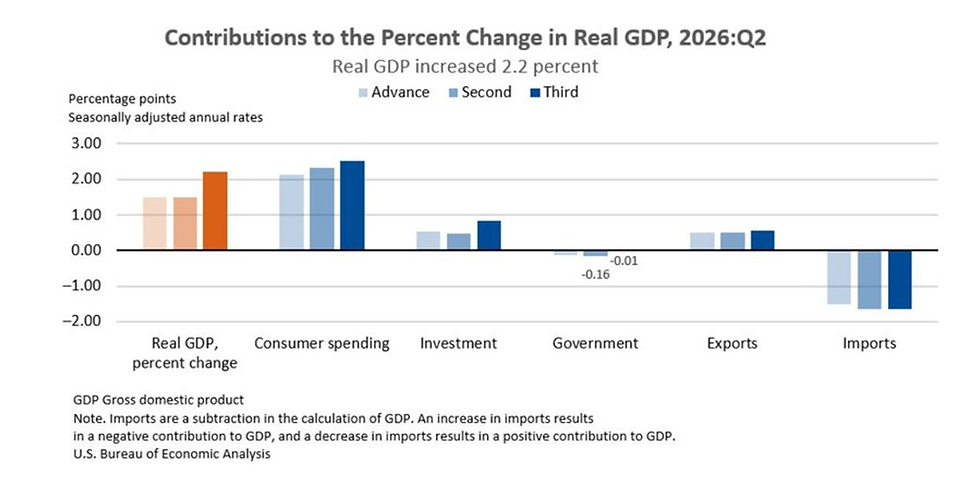
As you can see below, GDP accelerated as did GDI. We also had higher US consumption, exports and investment, along with lower government spending.
Right now, the US is the only G8 economy really growing, and it’s doing it by strengthening the private sector vs government. As you can see below in the real GDP estimates, US Q2 GDP revised up from 1.5% to 2.2%.