Where Is The "Pain Trade"?

1.) EXPOSURE – I try and discuss, fairly frequently, the importance of “the flows” and large asset manager positioning. Those things matter more than most anything else as it dictates the risk on or risk off nature that markets ebb and flow through.
So what do we know right now?
That the selling has already been huge. An average onlooker of markets wouldn’t know that since indexes in general have been very resilient in the face of that selling.
How much selling?
Non-dealers have sold $63.7 billion of S&P futures over the past six weeks; selling in five of those six weeks. The latest week added another $10.5 billion of selling, with asset managers responsible for $11.7 billion. Importantly, more than 70% of the six-week move came from long liquidation rather than new shorts (bets on a dropping market).
The market hasn't collapsed, but a lot of exposure has already left the building.
This gives us an interesting (and apparently unexpected) set up heading into Q3 earnings.
We have a tense macro backdrop (inflation accelerating, Iran war, Fed hikes, election) and extremely light positioning or exposure and very little panic in equity volatility (VIX) and the volatility of volatility (VVIX).
So we have non-dealers and asset managers having already sold big, but we also have the hedge fund side of the equation. What’s their deal?
Hedge fund US net positioning is in the 0th percentile! They have largely moved into protection mode with chips off the table into year-end.
The “I’m out of the market” side of the boat is looking fairly crowded. Probably good to take the other side even though it might “feel” wrong.
Your feelings betray you young Skywalker! Markets tend to deliver whatever results in the most amount of pain to the masses or consensus.
Right now, that “pain trade” appears higher…not a collapse.

2.) YIELDS – Could we be at the precipice of rates stopping going up so much? Maybe.
The equity liquidation I pointed out above has coincided with the surge in real yields. Of course, Gold doesn’t like rising real yields.
Interestingly, asset-manager gross longs (stock ownership) have developed a strongly negative relationship with 10-year real yields. The recent 0.25% jump in real yields came alongside another $5.5 billion of asset-manager long liquidation (selling).
From an institutional perspective, if real yields finally roll over, one of the biggest reasons for cutting equity exposure starts running in reverse.
What could be the catalyst for those real yields to start dropping? How about a reversal of bond volatility?
Often times, a signal to buy stocks is when the VIX spikes, creating a panic event of put buying. Volatility indicators are mean reverting, meaning spikes tend to deteriorate, which creates an environment where dealers have to sell those puts and/or buy futures. Well, the same dynamic can happen in the bond market as well.
The MOVE Index is the bond market’s VIX. The most recent resistance of that index was at 115.
Yesterday it tapped 114.46 and is currently down to 111 in the pre-market.
Could rates finally be at a level where bond managers decide the yield is worth it and they start buying?
Maybe.
Getting that MOVE Index to start it’s mean reversion would be a positive step in the right direction. If that’s to occur, this is a logical spot for it to start.

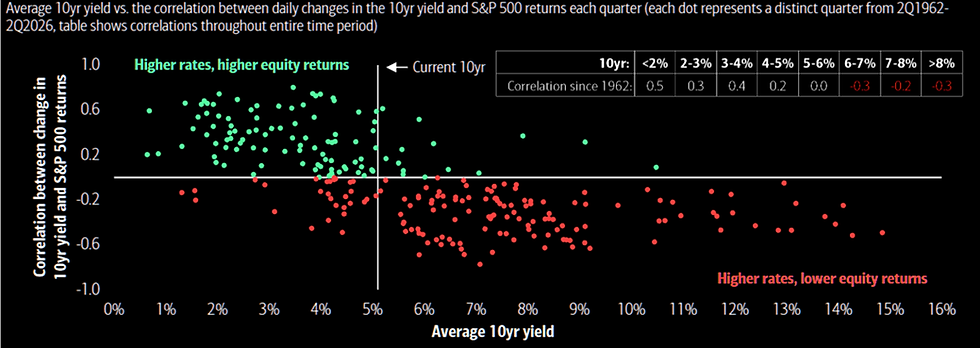
3.) 6% – The Bank of America analyst division has a useful way of thinking about the equity pain threshold as it relates to yields.
At 5%: investors historically became increasingly agnostic between bonds and equities. The current 10YR Yield is at 5.29%, near the S&P 500 earnings yield which is about 5.0–5.2% on forward earnings. So investors are still…sorta…meh.
At 6%: the relationship changes. Above here, higher yields have historically been associated with weaker equity returns.
At 7%: this is where the valuation damage becomes much clearer, with multiples compressing materially.
Yes, the 10YR Yield (all yields across the curve really) are bullish, or have an upward bias.
As pointed out above, the factor that could start to change that is if bond volatility can start dropping from here in a meaningful way.
I’m still not excited about bonds and, for the most part, neither are most of our models.