Does Concentration Equal Real Risk?

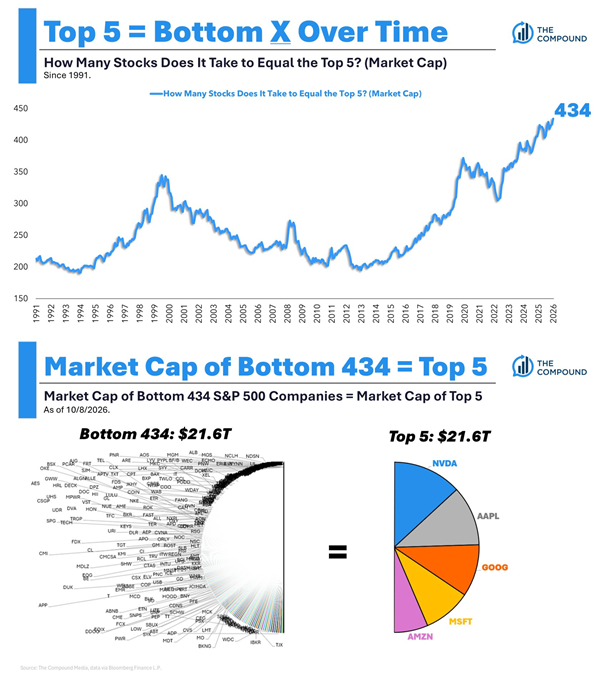
1.) CONCENTRATION – I’ve talked about “breadth” lately and that it isn’t great. More than 75% of stocks are down double digits. and over 37% are down 20% or more. That’s not usually anything to be excited about. Typically you want participation to be growing, not declining. But there’s another way to view it too. One of the main reasons so many breadth indicators are off the charts is because the concentration in the index is like nothing we've ever experienced. The top 5 stocks in the S&P 500 are equal to the bottom 434. Some people will get all worked up over that and say “…see…the end is near!”. Maybe it is, maybe it isn’t. I’m honestly not too worried about that right now. After all…those companies you see on the right side of the pie chart ARE making the most amount of money. Those 5 companies have trailing-twelve-month net income about equal to the bottom 436 S&P 500 companies. Isn’t that what markets do? Separate the money makers form the not-so-great money makers? Stanley Drunkenmiller...one of the greatest investors ever...takes the view that superior returns come from a few large, high-conviction bets. In other words he preaches concentration!
2.) MANGOS – Looks like there’s a new acronym in town. For years, we had FAANG - Facebook, Apple, Amazon, Netflix, and Google. Then Facebook changed its name to Meta. Google became Alphabet. Microsoft and Nvidia became impossible to ignore. That’s when we got the Magnificent 7. That’s stuck for a while, but apparently, seven isn’t good enough anymore. Now we have MANGOS…Meta. Anthropic. Nvidia. Google. OpenAI. SpaceX. The point is to identify the six companies supposedly defining the next era of technology, particularly artificial intelligence. Cool acronym and all, but what I find most interesting isn't the name itself. It's who's on the list, who's missing, and what that tells us about where investors are paying attention. Anthropic and OpenAI aren't even publicly traded companies…yet anyway. So right off the bat, a third of this new stock market acronym consists of companies the average investor can't even buy! That's a pretty big difference from FAANG. MANGOS is a collection of companies that people believe are going to shape the future. Just as importantly, look who’s missing. Apple isn't there. No Amazon. Microsoft is missing. And Netflix is long gone. These are some of the most successful businesses in history. Microsoft and Amazon are spending enormous amounts of money building out artificial intelligence infrastructure. Apple still has one of the largest installed bases of consumer devices on the planet. And none of that is enough to make the new “cool kids” list? That's what happens when narratives change. The companies don't necessarily become worse businesses. Investors just find something new to get excited about. We've seen this movie before. Through the decades we’ve had the Nifty 50, the dot.comers, FAANG, MAG7…etc. So, MANGOS is less about what cool new tech is or is not moving. It’s more about where the world's attention has shifted.
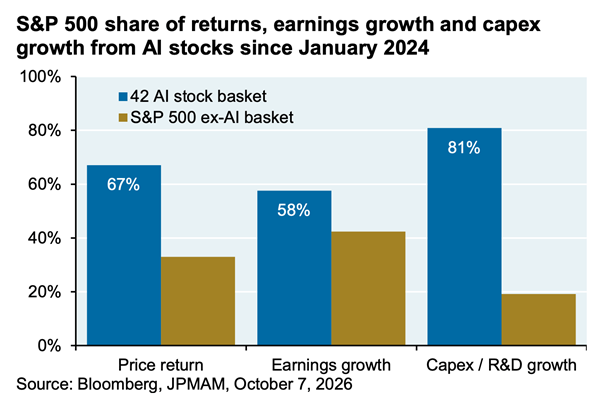
3.) AI – We all know that AI is real and here to stay. Some may think there’s no real value in it yet…in terms of company performance. This should tell the story. A basket of 42 AI stocks accounts for 60%-80% of all S&P earnings growth, price returns and capital spending since Jan 2024. Looks like the AI stuff is doing just fine.